Independent RISE study confirms performance benefits of Becker Daggerboards
How can wind-powered vessels translate more of the available wind energy into actual propulsion efficiency? An independent study by RISE Research Institutes of Sweden provides new insights into the role of anti-drift systems – and confirms the perfor-mance potential of Becker Daggerboards.
Wind propulsion is gaining momentum as the maritime industry works towards lower-emission shipping. However, sails and other wind propulsion systems generate significant lateral forces in addition to forward thrust. The resulting leeway can increase rudder angles, reduce sail performance and ultimately limit the achievable energy savings.
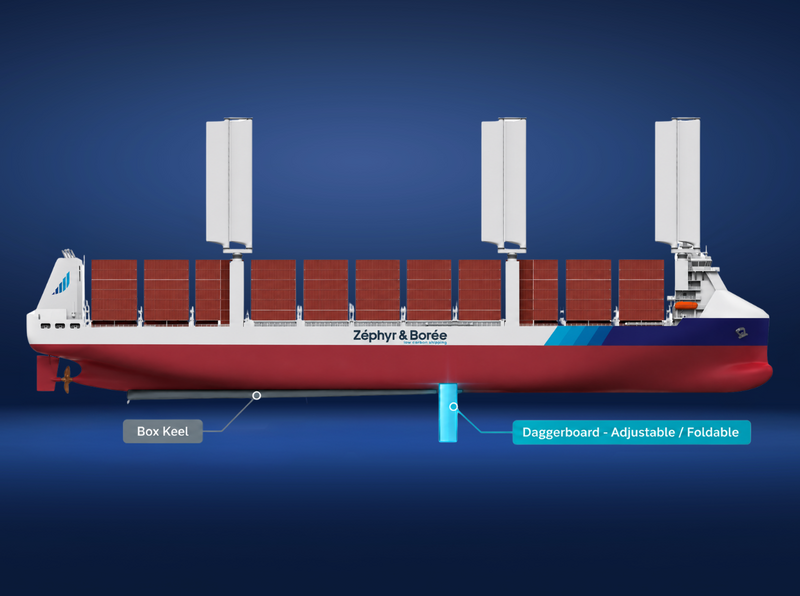
Together with Zéphyr & Borée and Becker Marine Systems, RISE investigated different anti-drift concepts for a wind-powered 2,700 TEU container vessel operating under realistic North Atlantic route conditions. The study compared a conventional box keel with passive and active daggerboard solutions, combining hydrodynamic CFD simulations, performance modelling, route and voyage optimisation and economic analysis.
Clear performance benefits for daggerboards
The results demonstrate a clear advantage for the daggerboard concepts. Both passive and active daggerboards significantly reduce leeway and rudder angles while enabling better utilisation of the available wind propulsion power.
For the investigated vessel and operating profile, the active daggerboard achieved the highest hydrodynamic performance, with up to 16 tonnes of additional VLSFO* savings per return trip. The passive daggerboard achieved up to 13 tonnes, while offering a particularly attractive balance between hydrodynamic performance, system complexity and economic viability.
“The results from this independent analysis conducted by RISE confirm the
effectiveness of our anti-drift daggerboards and highlight how they can contribute to
increased energy savings.”
- Sascha Kukowski, Head of Sales,
Becker Marine Systems
Looking at wind propulsion as a system
The findings underline an important principle: maximising wind propulsion efficiency requires more than installing sails. Aerodynamic forces and the hydrodynamic behaviour of the vessel need to be considered as an integrated system.
Our new Technical Insight – “How Becker Daggerboards Maximise Wind Propulsion Efficiency” takes a closer look at the study, its methodology and results, and explains how active and passive daggerboard concepts can support the next generation of efficient wind-powered vessels.